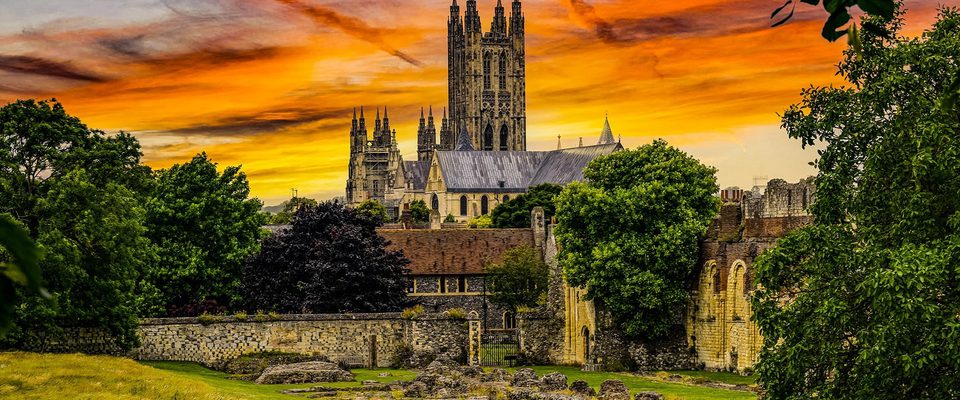
Celebrating Canterbury's Famous Women
From Queen Bertha to the first ever female Archbishop of Canterbury, celebrate the trail-blazing women of Canterbury
Canterbury's story has been shaped by remarkable women over the centuries, from Queen Bertha to the first-ever female Archbishop of Canterbury. As International Women's Day approaches, we are celebrating the trailblazing daughters and pioneers of our city.
Be sure to check out Women's History Month and the Curation of Female History at The Beaney House of Art and Knowledge.
Queen Bertha (circa 565- in or after 601) was Queen of Kent, married to pagan King Ethelbert of Kent. She came from Northern Europe and was a Christian. Bertha worshipped at St Martin's Church-the oldest church in continuous use in the English-speaking world-and supported the mission of St Augustine when he arrived from Rome in 597 to reconvert the Anglo-Saxons to Christianity. Without Bertha's influence, Canterbury may never have become the spiritual heart of English Christianity. You can visit her statue on Lady Wootton's Green, and visit St Martin's Church daily.

Aphra Behn (1640-1689) is widely regarded as one of the first professional female writers in the English language, churning out poems, plays and novels while also (it was whispered) serving as a spy! Born in Canterbury, she defied the societal constraints of her time by earning her living by writing for the stage and producing bold, witty works exploring politics, female desire, and gender dynamics. Her success paved the way for future generations of female writers, and in 2025, a brand new statue of Behn was unveiled in Canterbury outside The Beaney.

Mary Tourtel (1874-1948) is the creator of the beloved children's character Rupert the Bear, and was born and raised in the city and is buried at St Martin's Church. Tourtel drew inspiration from English village life and Kentish countryside scenes for her stories. First published in the Daily Express in 1920, Rupert Bear became a national icon, and Tourtel's work left a lasting mark on British children's literature and popular culture. A plaque marks her final home on Ivy Lane in the city, and a special display of Rupert the Bear is on display at The Beaney.

Audrey Williams (1902-1978), the pioneering archaeologist, made significant contributions to the understanding of Anglo-Saxon burial practices in England. She led the excavations that uncovered the mosaic corridor and the underfloor heating system, which are now the centrepieces of the Canterbury Roman Museum. At a time when archaeology was still a male-dominated field, Williams' work stood out for its rigour and had a lasting academic value. Visit her discoveries at Canterbury Roman Museum.

Sarah Mullally (born 1961) is one of Canterbury's modern female icons as the first-ever female Archbishop of Canterbury, installed on 25th March 2026. Before her religious vocation, Mullally trained as a nurse, laying the foundations for a life of public service as a nurse, midwife, and the former Chief Nursing Officer for England. She was installed as Bishop of London in 2018 and made history as the first female leader of the Church of England.
MODERN ICONS
Did you know the following famous faces have ties to Canterbury?
- Singer-songwriter Ellie Goulding (attended University of Kent)
- Singer-songwriter Mimi Webb (born and studied in Canterbury )
- Singer, songwriter, and producer PinkPantheress (grew up in Canterbury)
- Michelin-starred Angela Hartnett (born in Canterbury)

Stay Up To Date
Sign up to our newsletter to get regular updates on things to do and upcoming events in Canterbury, Herne Bay and Whitstable straight to your inbox