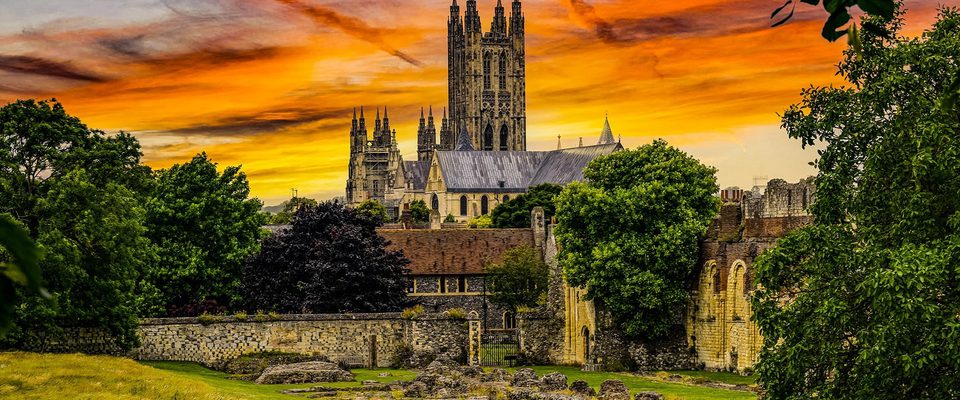
Greyfriars Garden
Discover Greyfriars Gardens, a tranquil riverside retreat where nearly 800 years of Canterbury’s Franciscan history survives amid ancient walls and the remarkable medieval chapel.
Discover Greyfriars Gardens, a tranquil riverside retreat where nearly 800 years of Canterbury’s Franciscan history survives amid ancient walls and the remarkable medieval chapel.
In January 2023, Canterbury City Council was awarded £19.9m by UK Government for the bid, Connected Canterbury: Unlocking the Tales of England. The project transformed Canterbury’s public spaces and heritage to reflect its status as an international visitor destination and World Heritage Site.
History of Greyfriars Gardens by Purcell Architecture
Franciscan Foundations
This area forms part of the former Franciscan Friary or Greyfriars site. The Franciscans were a mendicant order founded by St Francis of Assisi in 1209 who set out to spiritualise the masses through an itinerant life of preaching and poverty. A mission, sent from Italy, reached England in 1224, comprised of nine friars. They were led by Angellus of Pisa. They initially lodged at the Poor Priests Hospital, before they were granted a small island to the south of the large isle of Binnewith by Alexander, master of the Hospital, for their use.
On this plot of land, a small chapel was constructed, which was held by the citizens of Canterbury, but used by the Franciscans, who were not permitted to hold property.
In 1268, John Dygg, an alderman of the city and later its bailiff, purchased the island of Binnewith to the north of the existing friary, and bought access to Binnewith from Stour Street in the south. Dygg allowed the Franciscans to occupy the land before it was eventually transferred into their ownership.
It was in the latter half of the 13th century that the Franciscans built themselves a permanent friary complex in stone. The Friary included accommodation for around 35 friars and a substantial church, which was consecrated in 1325. By the early 14th century their holding of land extended to around 18 acres.

Dissolution of the Monsateries
In 1534, in the period of religious schism which preceded the Dissolution of Monasteries, Henry VIII appointed a new Franciscan prior and forbade the Franciscans from leaving the priory. In 1538 Richard Ingworth, the Bishop of Dover, came to Canterbury to dissolve the Dominican and Franciscan Friaries. Although they were heavily indebted at the time, their property was valuable enough to cover these debts.
In October 1538 the Archbishop of Canterbury, Thomas Cranmer, sought to secure the disposal of the Greyfriars site to one of his associates, writing to Thomas Cromwell, architect of the Dissolution of the Monasteries: ‘as the Grey Friars, Canterbury, is very commodious for my servant, Thomas Cobham, brother to Lord Cobham, I beg you will help him to the said house.’ These calls fell on deaf ears, for the property was sold to Thomas Spylman in 1539, one of the Court of Augmentations officers responsible for disposing of former church property.
In 1544 Spylman sold his holdings to Thomas Rolf for £100. This sale included the Friars’ house and two messuages, two orchards, two gardens, 3 acres of land, 5 acres of meadow, and 4 acres of pasture. Rolf then subdivided the estate and sold much of it to William Lovelace in 1565-6. By the time Lovelace had purchased the property, the part of the friary complex had likely already been converted into a house.

And rest is history...
In the 18th century, much of the present Greyfriars Gardens site was cleared of buildings. The only remaining building was Greyfriars Chapel, the building in the middle of the river, used as a lockup for prisoners, even holding some French prisoners of war, captured during the Napoleonic Wars.
After a stint as a tea garden in the 19th century, the Greyfriars Garden site became a publicly accessible market garden from c. 1914. Meanwhile, the last surviving building of the Greyfriars complex was restored in 1919 by Major HG James, then owner of the Greyfriars estate.09
By 1947 James was considering whether the Franciscan Order should return to the building for the first time in 400 years, with plans for the re-establishment of the order in Canterbury lodged with the council. This building now known as the Greyfriars Chapel, was purchased from James’ inheritors in 1959 by the Dean and Chapter of Canterbury Cathedral in 1959 and is now held by Eastbridge Hospital.
The only remaining building associated with the Friary is Greyfriars Chapel, straddling the river. Bookable visits to the Franciscan Gardens and Chapel are available HERE

Stay Up To Date
Sign up to our newsletter to get regular updates on things to do and upcoming events in Canterbury, Herne Bay and Whitstable straight to your inbox