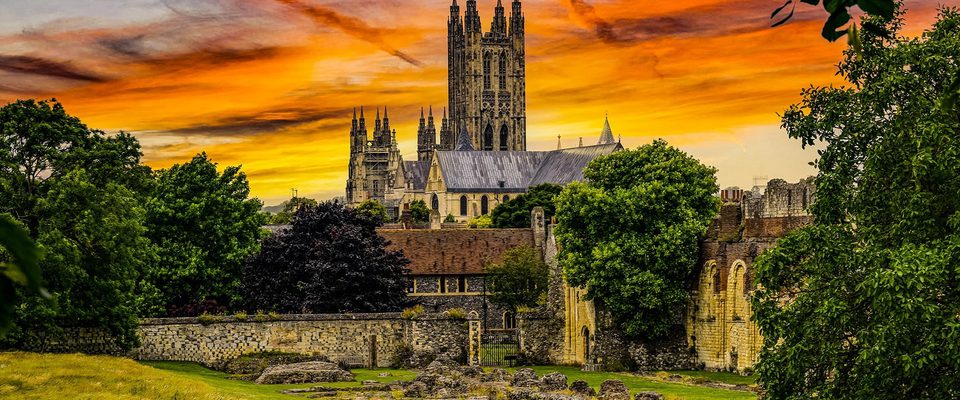
Three Cities Garden
Preserving the memory of a lost medieval parish, where centuries of worship and burial have given way to a peaceful public space
Three Cities Garden quietly preserves the memory of a lost medieval parish, where centuries of worship and burial have given way to a peaceful public space.
In January 2023, Canterbury City Council was awarded £19.9m by UK Government for the bid, Connected Canterbury: Unlocking the Tales of England. The project transformed Canterbury’s public spaces and heritage to reflect its status as an international visitor destination and World Heritage Site.
Three Cities Garden occupies the former churchyard of All Saints Church, a medieval parish church that was established by around 1200, although surviving parish registers begin in 1559. One of the earliest depictions of the church appears on Braun and Hogenberg's 1588 map of Canterbury, showing a prominent square tower beside the River Stour on the High Street. The area surrounding the church was once densely occupied by medieval religious buildings, including the now-lost churches of Greyfriars and Blackfriars.
By the late 16th century, the area now forming Three Cities Garden lay to the north of the church, enclosed by walls and neighbouring buildings, with the River Stour and Kings Mill to the west. Historical evidence suggests the site did not always serve as the churchyard. Antiquarian William Somner recorded in 1640 that the land had originally belonged, at least in part, to Eastbridge Hospital before becoming a burial ground, probably from the 14th century onwards. By the mid-18th century it was firmly established as the church's graveyard.

The medieval church underwent significant changes over time. Its original square tower, which projected into the roadway, was demolished in 1769 when Kingsbridge was widened to improve traffic flow. A smaller cupola containing a clock and bell replaced the tower on the roof ridge.
By the early 19th century the church was considered damp and architecturally unremarkable, standing close to the river below the level of its surrounding graveyard. In 1828 the medieval church was demolished and replaced by a new Gothic-style brick church set further back from the High Street, creating a landscaped buffer around the building. Contemporary commentators were critical of the Victorian rebuilding, describing it as lacking the character of the earlier church.

Nineteenth-century mapping shows the rebuilt church surrounded by a generous churchyard planted around its edges. The Victorian church survived until 1938, when it too was demolished. Archaeological investigations carried out in 1986 uncovered remains of both the medieval and Victorian churches, including foundations of the tower and sections of walling.
Today the former churchyard survives as Three Cities Garden, created in 2010 to celebrate the twinning relationship between Canterbury, Vladimir (Russia) and Bloomington-Normal (Illinois, USA). The gravestones have been relocated to the garden's perimeter, while a pavement plaque on Best Lane marks the position of the lost church.

Stay Up To Date
Sign up to our newsletter to get regular updates on things to do and upcoming events in Canterbury, Herne Bay and Whitstable straight to your inbox