Solly's Orchard
From medieval monastery orchard to riverside green space, Solly's Orchard and Abbot's Mill reveal centuries of faith, industry and life along the River Stour.
In January 2023, Canterbury City Council was awarded £19.9m by the UK Government for the bid, Connected Canterbury: Unlocking the Tales of England. The project transformed Canterbury’s public spaces and heritage to reflect its status as an international visitor destination and World Heritage Site.
History of Solly's Orchard by Purcell Architecture
Orchard for Blackfriars
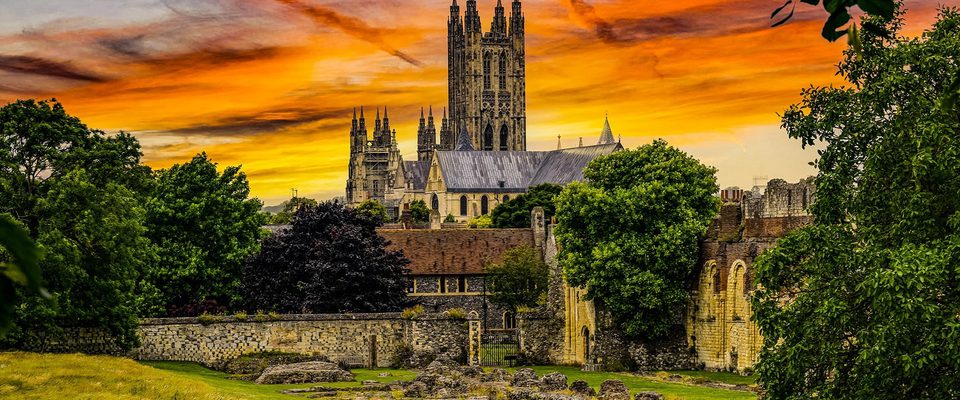
Solly's Orchard originally formed part of the Blackfriars Priory, established in the 13th century. In 1237, Henry III granted the Dominican Order land within the city walls on the banks of the River Stour, together with timber and around £500 to build a church and priory. The church was completed by 1244 and dedicated to Edward the Confessor, while the remaining monastic buildings were established by around 1260. The priory was arranged around a cloister, with the church to the south, dormitory to the north, refectory to the west, and guest hall situated on an island in the River Stour.
The priory precinct extended across what are now Mill Lane, King Street, The Friars and St Peter's Lane. Solly's Orchard served as the monastery's orchard, thought to have been planted with apple trees. A gatehouse stood near the south-east corner of the present orchard, linking the orchard with the guest hall.

Henry VIII and beyond
Following the Dissolution of the Monasteries in 1538, the priory was suppressed and the buildings were converted into a weaving factory. Contemporary maps show Solly's Orchard remaining as open ground while the former monastic buildings survived nearby.
By the mid-17th century, almost all of the friary buildings had disappeared, leaving only the medieval guest house, refectory and parts of the flint boundary wall. The bridge connecting the guest hall to the main priory buildings gradually fell into ruin before eventually being demolished.
18th century maps show the orchard continuing in agricultural use as both an orchard and kitchen garden. By the time of the 1873 Solly's Orchard had become a large open space, while the former watercourse separating the guest house from the orchard had been infilled.
During the 20th century the orchard remained planted with fruit trees, as shown in aerial photography from 1948, laid out with a grid of paths. In the second half of the century many of the orchard trees were removed and replaced by the perimeter paths seen today.
Nearby surviving Blackfriars buildings were restored and given new uses, including the former guest hall, which was rescued from ruin in 1979 and now survives, while the refectory became an art school and gallery for King's School.

Abbot's Mill
Abbot's Mill is thought to have existed since the early medieval period. In the early 12th century, Abbot Hugh II of St Augustine's Abbey purchased the mill from Stephen, giving the site the name "Abbot's Mill". The abbey retained ownership until the Dissolution in 1538, when Henry VIII leased the mill and its fishing rights to Walter Trotte.
Sixteenth-century maps depict the mill straddling the River Stour, with bridges connecting it to both banks and a leat directing water through the mill wheel. In 1791, the lease passed to Simmons and Royle, who commissioned engineer John Smeaton to design a completely new six-storey corn mill at a cost of nearly £8,000. Built using some stone reused from Canterbury's city walls, the new mill was capable of grinding between 500 and 700 quarters of corn each week.
Plans produced in 1828–29 show a sophisticated industrial complex including a counting house, meal shop, wagon lodges and drying oast. Although the mill buildings have since disappeared, the overall layout of the waterways and mill leat changed very little over the following two centuries. The surviving cast-iron bridge and sluice date from this period.
During the 19th century the mill continued producing flour and later became known as Denne's Mill after passing into the ownership of the Denne family. Standing six storeys high, it dominated the surrounding townscape.
In 1933 the mill was destroyed by fire. Today only the Grade II listed footbridge, sluice, cast-iron columns, wheel shaft and associated water-management features survive, preserving evidence of nearly 800 years of milling on the site.

Stay Up To Date
Sign up to our newsletter to get regular updates on things to do and upcoming events in Canterbury, Herne Bay and Whitstable straight to your inbox